Jungian Archetypes: Tarot as One Tool for the Deeper Work
My Introduction to Archetypes
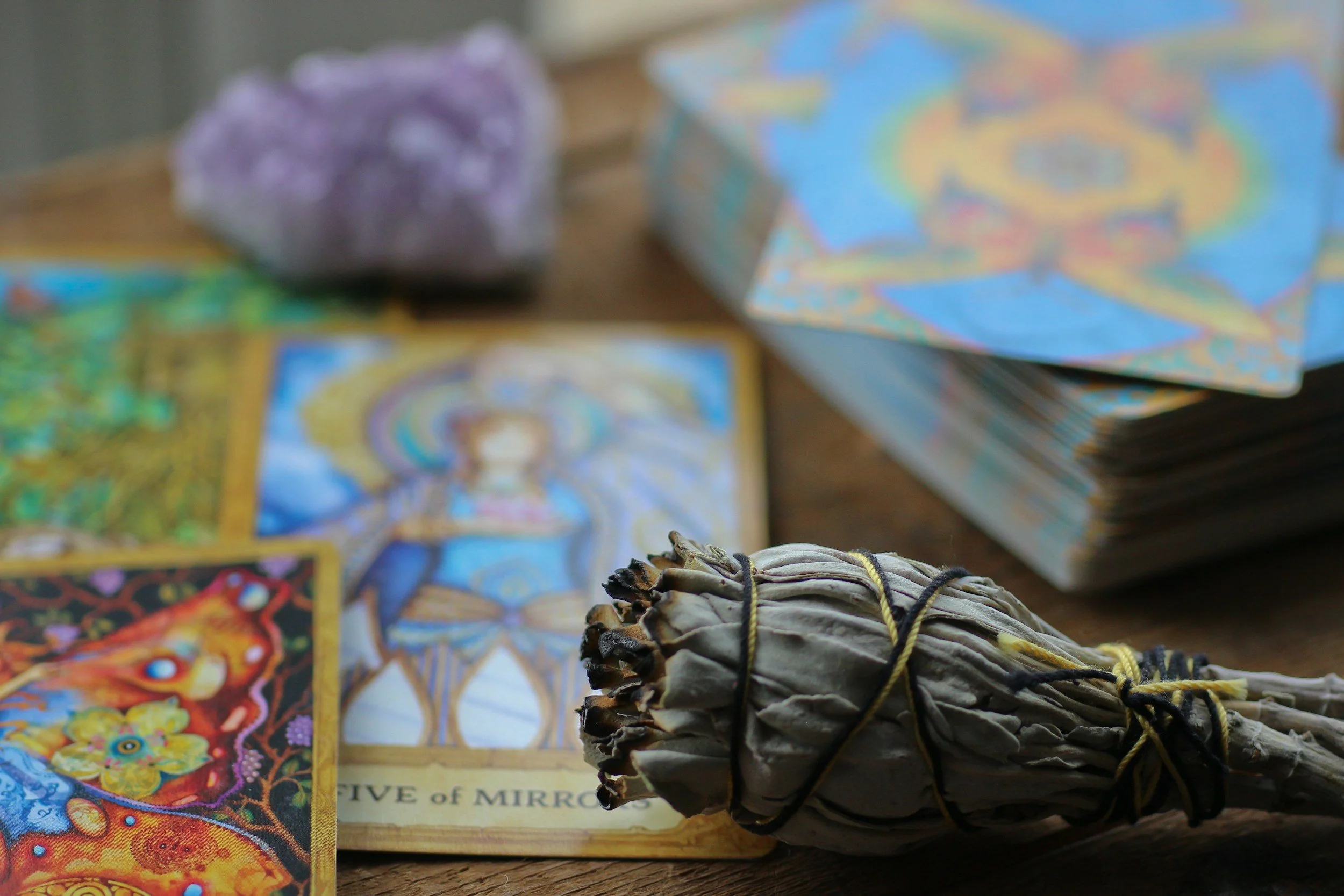
I got my first tarot deck before I was ten years old, in Montana. I did a reading on my grandmother, and the Death card came up. I didn't yet know that Death in tarot rarely means literal death — it means ending, transformation, the closing of one chapter so another can open. I just saw the image and panicked. I cried and cried, put the deck away, and didn't pick one up again for many years.
What scared me as a child wasn't really the card. It was the sense that something bigger than me had just spoken, and I had no framework for what to do with that. I think this is closer to the actual experience of meeting an archetype than most people realise — not a tidy personality trait revealing itself, but a force showing up, larger than the moment, asking to be reckoned with rather than simply interpreted. It took me years, and a long detour through Carl Jung, to understand what had actually happened in that reading.
I want to be clear about something before we go further: this piece is about archetypes. Tarot is simply one tool I use to study them — a doorway, not the destination. The real subject is the patterns underneath the cards, not the cards themselves.
A Brief History of Archetypes and Tarot
Tarot itself is younger than people assume. The earliest decks emerged in fifteenth-century Italy as playing cards for a game called tarocchi, used by Italian nobility, with no occult function at all. It wasn't until the late eighteenth century, in France, that occultists began layering esoteric meaning onto the cards — connecting them to Egyptian mysticism, Hermeticism, and eventually the Qabalah.
The concept of the archetype is older and comes from an entirely different lineage. Carl Jung proposed that the unconscious has two layers. The personal unconscious holds what's specific to an individual — suppressed memories, early assumptions, the parts of the self that didn't fit the personality one was allowed to have. The collective unconscious sits beneath that: a vast layer of patterns shared across the entire species, not personal to anyone. Archetypes live here.
Jung described this as an ocean. Conscious, waking life is a small boat on the surface. The personal unconscious is the current just beneath the hull, shaped by individual history. The collective unconscious is the ocean itself — old, vast, and not owned by any one person. The Mother archetype, for instance, isn't a personality type or a description of any specific mother. Every living thing that gestates has one. The archetype is the universal pattern underneath the personal experience.
Tarot's Major Arcana became, by the twentieth century, one of the most coherent symbolic systems for externalising these patterns — largely through the work of the Golden Dawn, and later Aleister Crowley's Thoth deck, which deliberately mapped the cards onto the Qabalistic Tree of Life and onto astrology.
The Fool's Journey and the Hero's Journey
Read in sequence, the Major Arcana traces what's often called the Fool's Journey — naive beginning, trials, crisis, and eventual integration. It's the same shape Joseph Campbell mapped across world mythology as the Hero's Journey, the framework I wrote about in my very first post on this site. The Fool sets out without guarantee. He meets the Magician, the High Priestess, the Emperor — figures who teach him the use of will, intuition, and structure. He passes through the Tower, where everything he built collapses, and through Death, where an old identity finally ends. He arrives, eventually, at the World — not the same Fool he was, but someone who has integrated what the journey demanded of him.
This is the Hero's Journey told through twenty-two images instead of twenty-two chapters. Different door, same room. Campbell himself drew on Jung's archetypal theory when he built his model, so the two frameworks were never really separate — one simply uses narrative structure, and the other uses a sequence of cards, to describe the same universal arc every person walks through on the way to becoming more fully themselves.
Archetype Work in Psychology, and How It Connects to Internal Family Systems (IFS)
In clinical and depth-psychological use, archetypes serve a specific function: they externalise material that's otherwise too close to the self to see clearly. The Shadow holds whatever a person couldn't keep and still feel safe or loved within their early environment — it doesn't disappear, it goes underground and keeps operating without permission. The Hero, the Orphan, the Wounded Healer, the Trickster: these are strategies that calcified because they once worked, not fixed character traits.
Internal Family Systems, a popular modern therapy model often referred to simply as IFS, describes nearly the same territory in different language. IFS names Exiles — wounded parts carrying pain too overwhelming to feel at the time — and Protectors, which developed strategies to keep those Exiles from surfacing. Self, in IFS, is the calm core capable of relating to all of the parts without being run by any of them. This maps closely onto Jung's framework: the Exile is close kin to the Shadow, Protectors are close kin to the adaptive archetypal strategies, and Self plays nearly the same role Jung gave to the process of individuation.
The difference is mostly methodological. IFS gives a structured way to dialogue directly with a part in real time. Archetypal work tends to use an external image — a card, a myth, a dream symbol — as the entry point into the same material. For material that formed before language existed to describe it, an image can sometimes reach further than direct dialogue can.
What gets lost in the popularised, quiz-style version of archetypes — take a short test, become "The Sage," adopt a shinier persona — is that a real archetype carries genuine force, not just a label. It carries structuring power, organising experience around what's trying to emerge rather than what's already happened. Numinous power, felt as wonder or fragile preciousness. Transformative power, marking the start of real individuation. And symbol-producing power, surfacing in dreams and waking life as images of birth, light, treasure, or unlikely survival.
This is also where the real risk lives. A core task of individuation is protecting the ego from two failure modes when it meets genuine archetypal power. Inflation happens when the ego identifies as the archetype rather than relating to it — "I am the healer," "I am the chosen one" — which is the mechanism behind most gurus and leaders who start with real gifts and end up causing real harm. Deflation is the crash on the other side: collapse, worthlessness, a total loss of agency, often arriving right after an inflated identification fails to hold. Both are a loss of the boundary between the personal self and the archetypal force passing through it.
Interventions: Working With Archetypes Without Losing Yourself in Them
Start with the shadow, and don't go alone. Journaling and reading are valuable, but they rarely reach the genuinely uncomfortable material the ego has a strong interest in protecting. This work tends to need a second person — a therapist, analyst, or trained guide — because the ego's blind spots are, by definition, invisible from the inside.
Approach the archetype as a force, not a role to perform. Before working with archetypal material through dreams, tarot, myth, or active imagination, name what's actually happening: contacting a pattern, not becoming one. "I am working with the Hero energy in me right now" sits very differently in the body than "I am the Hero."
Separate the personal from the universal. Notice how your actual relationship — to your mother, your father, your early experience of safety or its absence — shaped your sense of the archetype underneath it. A cold personal mother often becomes, symbolically, a cold and untrustworthy world. Naming this split is often where real movement happens.
Track inflation and deflation as they happen, not after. Notice the early signs of identifying with a role — a creeping sense of being special or beyond ordinary feedback. Notice equally the signs of collapse — a single setback reading as total proof of worthlessness. Both are correctable once seen.
Use symbolic tools as mirrors, not identities. Look at the image, let it inform you, and set it back down. Picking it up and wearing it permanently is where the quiz version and the real version part ways.
Return to alignment, not reinvention. The goal was never a better personality. It's a widening of self-awareness that lets a person carry the pattern moving through them without being possessed by it.
Decks for Studying Archetypes
For anyone wanting to study this material directly rather than read about it secondhand, two decks are worth starting with. The Rider-Waite-Smith deck, designed in 1909, is the template most modern tarot is built on — intuitive imagery, drawing on Golden Dawn esoteric tradition. The Thoth deck, created by Aleister Crowley with artist Lady Frieda Harris, goes further: built to correspond with the Qabalistic Tree of Life and with astrology, so each card carries several layers of symbolic meaning at once.
I once had a collection of well over three hundred decks — tarot, Lenormand, Kipper, runes, all of it. There's real value in that breadth; it's often how you discover which symbolic language actually speaks to you. But eventually depth outweighed breadth for me, and Rider-Waite and Thoth are the two I've returned to ever since.
Coming Back to the Death Card
I think about that reading of my grandmother often now, the one that sent me running from tarot for years. I understand the Death card differently today than I did as a child — not as an omen, but as the most honest archetypal image there is: the closing of one form so another can take its place. That's also, in a way, the truest description of what archetypal work actually asks of us. Not a new personality to perform, not a prediction to fear, but a willingness to let an old shape end so something truer can be born in its place. The deck didn't teach me that at ten years old. The decades of returning to it, slowly, with better tools each time, did.
If this kind of work — psychology, archetypal symbolism, and grounded spiritual practice — speaks to where you are right now, I'd be glad to walk alongside you.
Megan Shea is a trauma-informed psychotherapist and yoga-informed holistic counsellor integrating depth psychology, somatic therapy, nervous system awareness, Vedic philosophy, and expressive arts. She works with adults online across Australia and worldwide.