

Your Life's Purpose Is Already There. You Just Haven't Seen It Yet.
I use a timeline exercise with clients that starts with drawing a single horizontal line. Then simply marking milestones — pleasant and unpleasant — above it and below.
I did it myself years ago. A few things surfaced I hadn't expected. After sitting with it a while, a pattern emerged, then a theme, and eventually something closer to purpose. I noticed I'd always valued time alone as much as I valued belonging. I was consistently drawn to creative outlets — music, photography, writing — and to investigating and exploring, a sense of adventure that ran alongside a pull toward spirituality and philosophy.
I was also the one friends brought their problems to, and I sometimes lost my own in theirs. Learning to stop doing that, and do the work myself instead, was its own marker on the line. These are things I still do today, just more consciously now. Other themes on the line were less comfortable to look at — self-betrayal, fear, disappointment, and others like them. This is close to what Jung wrote in Aion: that whatever isn't made conscious in us tends to play out in our lives anyway, as if it were fate.
Seeing a whole life on one page tends to do something a list or a conversation can't. Words repeat. Themes surface that were invisible while you were living inside them. And often, underneath the hard material, something emerges that was there the whole time — something that turns out to be closer to purpose than anything a job title or a five-year plan could capture.
That's the exercise. It sounds almost too simple to matter. In practice, it's one of the more clarifying things I offer clients — four steps that build on each other, not all at once.
Step One: The Timeline
Draw the line. Start with a dot at the very beginning — the year you were born. Work along from there, marking milestones as you go: relationships, graduations, celebrations, moves, anything that mattered.
Sort as you go. Positive milestones go above the line. Anything painful goes below it. If something feels too raw to write out in full, a symbol or initials is enough — the point isn't to relive it in detail, just to mark that it happened and where.
What "below the line" can look like. A parent who broke a promise, or left. A friend who told your secret. A partner's affair, or the moment you found out. A decision made in a spiral — quitting a job, ending a relationship, moving countries — that felt impulsive at the time and only made sense years later. A version of yourself you're not proud of. A single word or symbol under the line is enough to hold it.
Don't edit yet. This isn't about crafting a narrative — it's about getting the shape down. Most people are surprised by what surfaces once it's laid out along a line instead of floating loose in memory. A rocky few years might reveal itself as the root of something you've been fighting for a decade. A relationship you'd written off as insignificant might turn out to be the real turning point.
Check for what's missing. Once the line feels done, ask yourself one more question: what's the one thing I left off? There's almost always something. Add it now.
Once the line is down, sit with it for a day or two. Let it settle.
Step Two: Sitting With It
Pause at the present. When you reach the present moment on the line, stop. Take a few slow, full breaths into your belly. Then look back over the whole thing, start to now.
This part is, in essence, svadhyaya — one of Patanjali's niyamas, usually translated as self-study through observation. You're not analysing yet. You're witnessing what's on the page, the way you'd witness a thought passing in meditation, without needing to fix or explain it immediately.
Notice, don't force it. Notice what comes up. What words surface. What feelings move through you as you take in the above-the-line moments against the below-the-line ones. If it helps to have something more concrete, go back over the line item by item and ask three questions of each: What word comes to mind? What feeling comes with it? What thought follows right after? A word or two per question is enough — it's the act of asking that surfaces the pattern, not the length of the answer.
Let the pattern show itself. Not any single event, but something that repeats across several. Sometimes it's a wound resurfacing in different forms. Sometimes it's a strength you kept reaching for without realising it was the same strength each time. This is often where a sense of life purpose starts to emerge — not as an abstract idea, but as something you can actually see, laid out on the page.
This is also where themes like fear and self-betrayal get a real chance to be addressed — noticing where you've been living from fear rather than courage, or from self-betrayal rather than an honest, empowered truth. None of that is visible without seeing it laid out first. And seeing it changes the choices that follow. Not perfectly — nobody makes all the right calls, it's trial and error for everyone — but choices made from honesty tend to land better than ones made blind.
Where the hero's journey fits in. The line isn't just a record of what happened — it's the shape of a journey. The below-the-line moments are the calls to adventure and the ordeals. The above-the-line moments are what got brought forward from them. And the theme that emerges is close to what Joseph Campbell called the boon — what you bring back and offer, precisely because of what you went through, not despite it.
Step Three: Extending the Line Forward
Project five years out. Extend the line another five years past today, and project forward. What might the next five years hold, if the pattern you've just seen continues — or if you actively shift it?
This is the part that tends to land hardest. Seeing your whole life so far, and five years of your possible future, on a single sheet of paper, can be genuinely confronting — not because anything on the page is new information, but because you rarely see the whole span of a life at once, all in one glance. Some people find it sobering. Some find it clarifying in a way nothing else has managed. Either reaction is valuable.
Step Four: The Letter From Your Future Self (Optional)
Write from your future self. This is where it becomes more than a record. There's a body of research on what's called future self-continuity — the more vividly you can connect with the person you'll become, the more it changes the choices you make today. Once a theme has surfaced, write a letter — not about what happened, but from a specific vantage point: imagine yourself decades from now, at the end of a long life, looking back over the whole line, writing to the you who exists today.
There's something about the distance of that framing that cuts through the noise. That older version of you has already lived past whatever feels urgent or frightening right now. They know how it turned out. Writing from that place tends to produce something far more honest than writing "as yourself, today" — today's self is usually still too close to the material to see it clearly.
Questions to write toward. What would that older version of you want you to know? What do they understand now that you couldn't understand from where you're standing? What do they want you to stop holding onto, and what do they want you to keep?
You don't need a template for this. It just needs to hold a few honest things: what they know now that you don't yet, what they'd want you to put down, and what they'd want you to hold onto instead. It'll feel stiff for the first few sentences. That's normal. Keep going past them.
What tends to happen. What often surprises people, writing this letter, isn't the content — it's what happens to their vantage point. You find yourself stepping outside your own experience, seeing it from somewhere just outside yourself, rather than from inside the feelings you usually write from. This is close to what the Vedic tradition calls the witness — sakshi — the part of us capable of observing our own life without being fully swallowed by it. From that vantage point, a kind of understanding and compassion becomes available that's almost impossible to access from inside the story itself. Not because you're avoiding the feeling, but because you're finally seeing it, rather than simply being it.
Why the sequence matters. Writing the letter first tends to produce something generic — nice sentiment, disconnected from the actual material of your life. The line, and the theme that emerges from sitting with it, is what gives the letter somewhere real to stand. It's the difference between telling yourself you've grown, and being able to point to the exact spot on the page where it happened.
This isn't one-and-done. Worth repeating every few years — the line itself doesn't change, but what you notice on it does. The events stay fixed. Your relationship to them keeps moving.
Looking back at a finished line, the story arc is often visible quite literally, laid out on paper. The call to adventure. The threshold you cross when you can't go back to not knowing. The abyss — the lowest point, where the old story stops working and nothing new has replaced it yet. And then the return, bringing back something you didn't have before you went in. Most people can point to their own version of this arc once they see the whole line at once. It's rarely visible living inside it, day to day. It becomes visible from a distance.
Why This Matters Clinically
This exercise sits at the intersection of a few frameworks I draw on, and they're not decorative — they're why it works the way it does.
Life Review Therapy. The timeline draws directly on this structured approach to autobiographical recall, developed by psychiatrist Robert Butler in the 1960s. Decades of research since, including several meta-analyses, have found life review reliably improves life satisfaction and reduces depressive symptoms. Later researchers such as James Birren built on it as Guided Autobiography, and more recent work has combined life review with narrative therapy directly, to help people find new, more workable meaning in old events rather than simply recalling them.
Expressive writing. The letter draws on a separate but related evidence base, developed by psychologist James Pennebaker. Decades of controlled research have found that writing about difficult experiences in a structured way — building them into a coherent narrative with a beginning, middle, and perspective — helps the brain process and integrate memories that otherwise stay fragmented and emotionally activating. This is part of why the letter works better after the timeline than before it: the material needs to be organised into some kind of narrative shape before writing toward resolution actually helps.
Narrative therapy. This holds that we don't just live our lives — we live the story we've built about them, and that story can trap us as easily as it frees us. Most people arrive at therapy with a story that has stopped making sense. A betrayal. A life transition. A loss that doesn't fit anywhere. The line, and the theme that emerges from it, is a way of getting underneath the story you've been telling yourself and finding the more honest one underneath — not to erase the old story, but to see it clearly enough to write past it.
Expressive arts. This is also, quietly, part of the same tradition. The moment you choose a symbol instead of a sentence for something too raw to write out — that's not a shortcut, it's the whole point. Some material doesn't want to go through words first. A mark, an initial, can hold something your verbal mind hasn't found language for yet, and that's often exactly where the most useful material is sitting.
Trauma work. Even when nothing on the page looks dramatic. Trauma isn't only the large, obvious events — it's often what wasn't integrated, the moments marked below the line and never looked at again, held unprocessed rather than metabolised. Seeing them laid out, named, and connected to a wider pattern is itself a form of integration. Not retelling the story to make it hurt less, but finally placing each piece where it belongs in a whole life, rather than letting it float, disconnected, doing its damage quietly.
The hero's journey, earned. That story only makes sense because of the ordeal — the descent is what makes the return meaningful, and what's brought back afterward is only valuable because of what it cost. Seeing your own line this way isn't about dressing up pain in mythology. It's recognising that the theme running through your below-the-line moments, and the boon that comes from having survived them, are the same thing seen from two different angles.
This is precisely the work I do with people who arrive because the story they were living in has stopped holding together — helping them find, integrate, and eventually author a truer one.
A life is not a straight line, even when we draw it as one. It's a spiral, returning again and again to the same terrain, each time from a little higher up. The point of drawing it out isn't to explain yourself. It's to finally see the shape you've been living inside, so you can decide, with open eyes, whether to keep living inside it, or write what comes next.
You already know your theme. Most people do, somewhere underneath the noise. This is simply how you get quiet enough to hear it.
I still write. I still travel. I still explore. Those threads never disappeared — they simply became more conscious. None of it arrived with a qualification — it was on the line long before that. Yours is on yours too.
Want to go deeper? Read: The Hero's Journey — A Map for Your Transformation.
What Happens Next?
Your story already holds the answers. Sometimes it just takes another person to help you see the patterns, understand the journey, and find what comes next.
If you're feeling stuck, repeating the same patterns, navigating a major life transition, or searching for greater meaning, this process can help you make sense of your experience and move forward with clarity and purpose.
Book an online session →
Megan Shea is an American-trained psychotherapist, AMHSW, integrating evidence-based psychotherapy with depth psychology, nervous system regulation, somatic approaches, Vedic philosophy, and the Hero's Journey. She works with adults navigating trauma, relationship patterns, recovery, and major life transitions — online, across Australia and internationally, including clients relocating, travelling, or living between places.
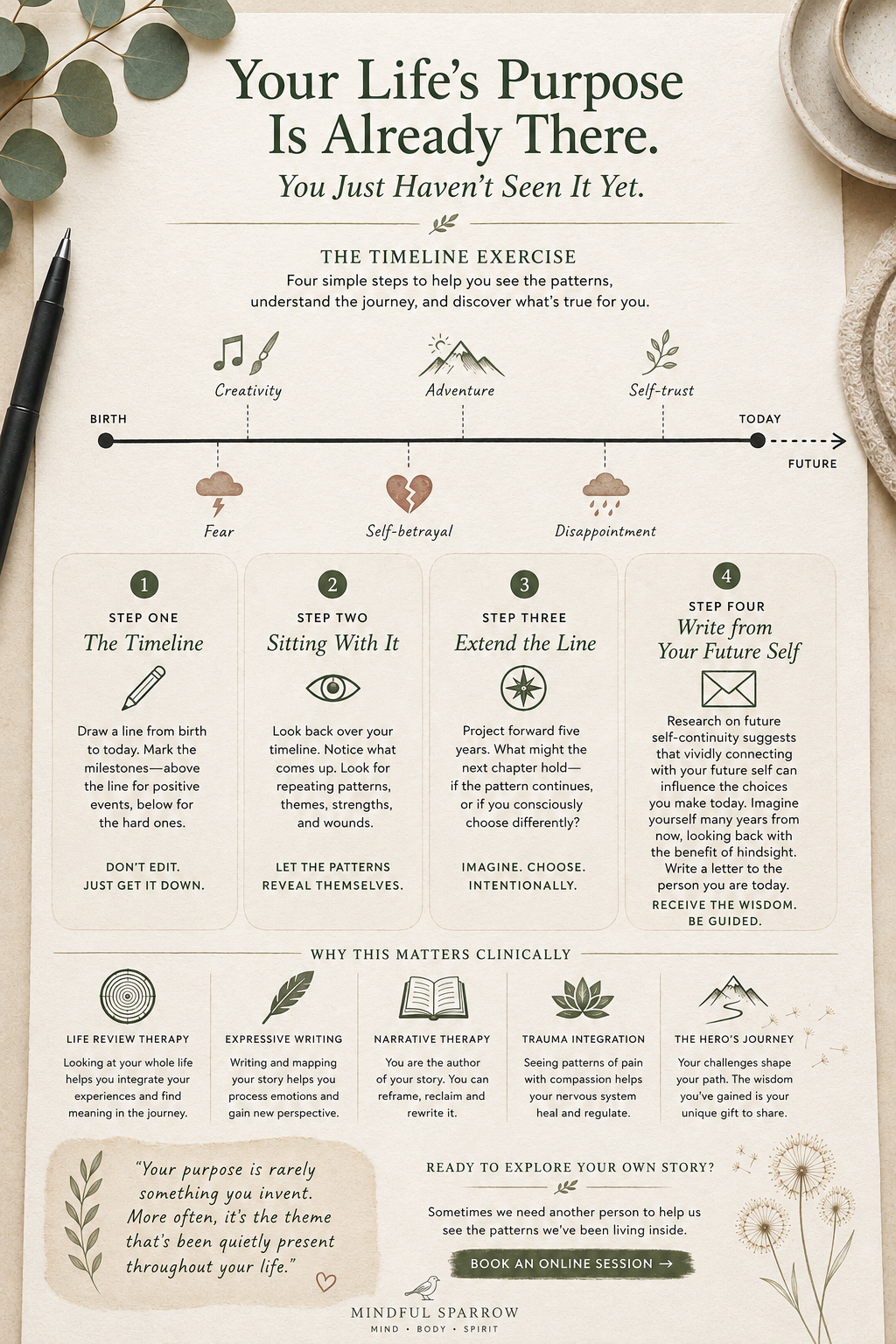
The Timeline Exercise
