
The Hero's Journey: A Map for Your Transformation
I was sixteen years old in 1988 — playing in the symphony, going to punk rock shows, writing poems, doing all the things a Gen X teenager does. And somehow, in the middle of all of that, I kept coming back to Bill Moyers interviewing Joseph Campbell on PBS.
I couldn't have told you why it gripped me the way it did. I just knew that whatever Campbell was talking about mattered. That the stories he was describing — the call, the descent, the return — weren't just ancient myths. They were something alive. Something I recognised, even at sixteen, even without the language for it.
What it gave me was hope. And a reference point. A map.
I didn't know then that I'd spend the rest of my life helping people use it. But almost every session I sit in as a therapist is, at its core, the same work: helping someone become the hero of their own journey. Helping them recognise where they are on the map — and trust that the territory, however disorienting, is navigable.
This is that map.
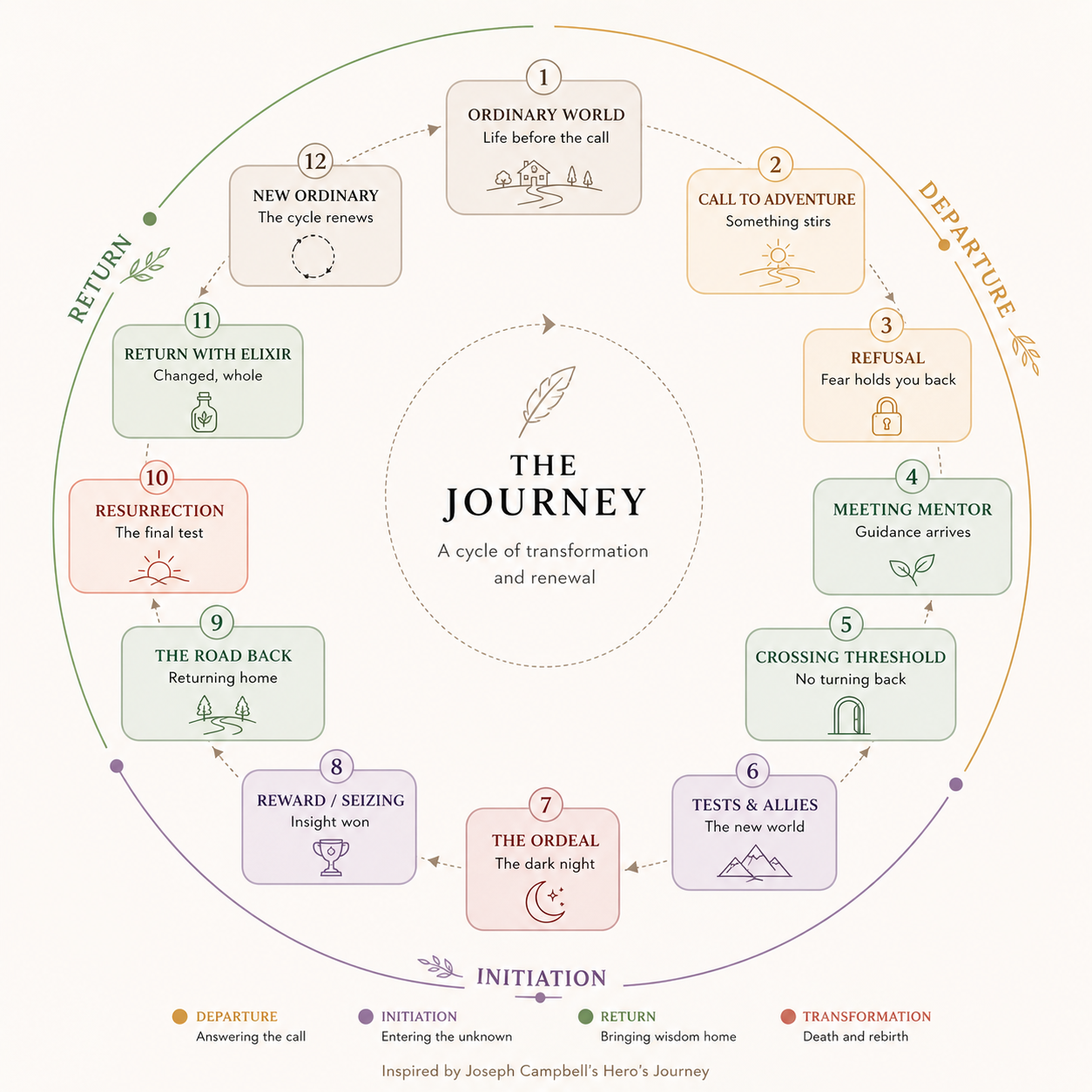
The mythologist Joseph Campbell spent decades studying the stories humans tell — across cultures, across centuries, across every tradition he could find. What he discovered was that beneath the surface differences, the same essential pattern kept appearing. He called it the Hero's Journey — a universal template for transformation that shows up in ancient myth, religious narrative, fairy tale, and the stories people tell about the most significant passages of their own lives. Campbell wasn't describing a story about exceptional people. He was describing something far more intimate: the psychological journey every human being faces when life calls them toward genuine change. "The cave you fear to enter holds the treasure you seek." That's not a metaphor about caves.
Carl Jung arrived at the same map from a completely different direction. Where Campbell studied world mythology, Jung studied the human psyche — dreams, symbols, the patterns that emerged across thousands of hours of clinical work. What he found mirrored what Campbell found in story: a fundamental drive in the human psyche toward wholeness, toward becoming more fully oneself. Jung called this process individuation — the lifelong movement toward integrating the full range of who we are. Not just the acceptable, polished parts, but the shadow, the depth, the unlived life, the parts we suppressed or never knew were there. For Jung, the symptoms that bring people to therapy — the anxiety, the recurring patterns, the sense that something essential is missing — are often not pathology in the conventional sense. They are the psyche's insistence that the journey begin. The crisis, in other words, is often the call.
The journey begins in what Campbell called the Ordinary World — the known life, structured around a particular version of who you are. Jung called this the persona, the identity constructed for the world. Useful, necessary, and in many ways genuinely expressive of who you are — but not the whole self. This is the stage people describe as going through the motions: a life that looks fine from the outside, that ticks all the boxes, but carries a quiet dissatisfaction that won't go away. The ordinary world is not the enemy. It is the foundation you will eventually leave, and one day return to, transformed.
Then something opens. A gap appears. The Call to Adventure arrives differently for everyone — a loss, a diagnosis, a relationship ending, a question you can't un-ask. Sometimes it's loud and obvious. More often it's a quiet insistence that builds until it can no longer be ignored. Campbell was clear that the call can be refused, and many people do refuse it, sometimes for years, filling the gap with busyness or the determined maintenance of a life that no longer fits. Jung understood the cost of refusal — when we ignore the call toward growth, the unconscious finds other ways to get our attention. The anxiety that won't settle. The recurring pattern that appears in relationship after relationship. The psyche is persistent. It will keep sending the message.
At some point — even involuntarily — you move. Crossing the threshold means leaving the familiar world behind and entering what Campbell called the field of adventure, the territory where the real work happens. What characterises this stage is the loss of the old coordinates. The familiar ways of understanding yourself no longer quite apply. You are somewhere between the person you were and whoever you are becoming, and that in-between space is deeply uncomfortable. Jung called this the beginning of the night sea journey — the descent into the unknown interior, the ego's familiar structures loosening, the deeper self beginning to make its presence known. This is where therapy often becomes most valuable — not to hurry the crossing, but to provide reliable ground while the familiar ground is shifting.
Then comes the Road of Trials — the heart of the journey, and the stage where people most often feel lost. Campbell understood these trials not as obstacles to the destination but as the destination itself. For Jung, this is the confrontation with the shadow — the meeting with everything disowned, suppressed, or never yet faced. The anger never expressed. The grief bypassed. The needs dismissed as too much. They don't disappear when we refuse them. They wait. And the Road of Trials is where they surface. The intensity of this stage is not evidence of failure. It is evidence of genuine process. The question it always asks is the same: What are you willing to release for who you're becoming?
The hero who returns is not the same person who left. Campbell insisted on the Return as essential — not just surviving the journey, but bringing something back. Integration. The wisdom of the trials metabolised into a way of living. Jung called this the shadow met and metabolised, the persona made more spacious, the self more fully inhabited. The Return is quiet. It doesn't announce itself. It shows up in the texture of daily life — in the quality of presence, in relationships that become more honest, in a body that finally begins to settle.
Wherever you are in this map — at the threshold, in the trials, somewhere in the in-between — you are not behind. You are not doing it wrong. There is no correct timeline for the journey. What matters is whether you are moving consciously, with enough support to stay in the fire without it burning you down, with enough grounding to let the descent do its work. That is what depth therapy is for — not to fix you or fast-track you through the hard stages, but to help you navigate with more awareness, more support, and less unnecessary suffering.
The map doesn't make the journey easier. But it makes it legible. And sometimes, that's exactly what hope looks like.
The treasure is in the cave. The cave is the work.
If you're somewhere in the middle of your journey and ready for real support, I'd be glad to walk alongside you.
Want to go deeper? Read the next post: The Medicine Wheel — A Guide to Whole-Life Balance.
Megan Shea is a trauma-informed psychotherapist and yoga-informed holistic counsellor integrating depth psychology, somatic therapy, nervous system awareness, and yogic wisdom. She works with adults online across Australia and worldwide.