The Medicine Wheel: A Guide to Whole-Life Balance
I didn't encounter the Medicine Wheel in a book.
I grew up in Montana and the Pacific Northwest, where Indigenous culture wasn't something distant or academic — it was woven into daily life, into friendships, into relationships that shaped who I became. I was introduced to the customs and ceremonies of tribal people by the people themselves, and that introduction has been one of the most formative threads of my life. The Medicine Wheel entered my world that way. Not as a concept borrowed from a shelf, but as a living practice, offered generously by people whose wisdom I continue to honour.
If you've read the Hero's Journey post, you already have the map. The Medicine Wheel is what I learned to navigate by before I had that language — not from a book, but from people.
The wheel has no beginning and no end. You don't arrive at it and you don't complete it. You simply enter it — wherever you are — and begin to tend what is there.
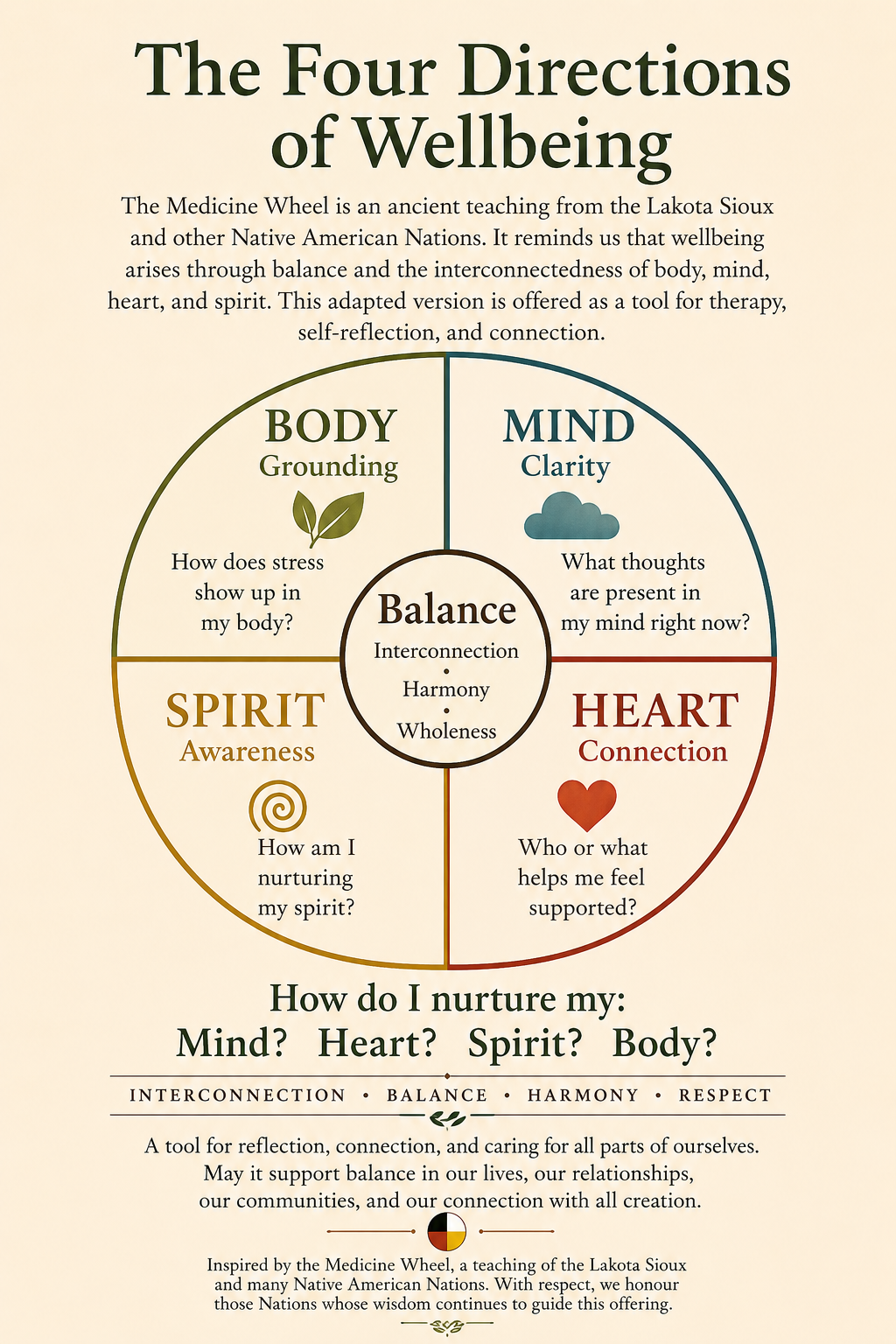
What I know from living with this teaching is that when I am genuinely nurturing all four directions every day — body, mind, emotion, spirit — something opens. I am in balance. I am in flow. I feel harmony with myself, with other people, with the earth and the sky, with the two-legged and the winged ones and everything that shares this world. That is not a metaphor. It is a felt reality, and it is available to anyone willing to pay honest attention.
Joseph Campbell and Carl Jung both pointed toward something that Indigenous cultures around the world had always known — that the same essential wisdom keeps appearing, in different forms, across every tradition and every century. The Medicine Wheel is one expression of that wisdom. So are the five Vedic elements. So is the Hero's Journey. They are not the same teaching, but they are describing the same human truth: that we are whole beings, that every part of us deserves tending, and that when we neglect one dimension of ourselves, the whole suffers. What moved me, years later when I deepened into yoga and Ayurveda, was the recognition — immediate and clear — that these traditions had always been speaking to each other across time and distance.
The wheel holds five directions. The East is the place of dawn and the mind — clarity, fresh perception, the capacity to see what is actually in front of you rather than what you fear or expect. The South is full summer feeling — the emotional body, the heart, the full range of what it means to love and grieve and connect. The West is dusk and the spirit — the turning inward, the slow work of reflection, the questions that matter beyond the daily noise. The North is winter and the body itself — rest, nourishment, the physical ground without which nothing else is possible. And at the centre stands the self. Not a destination, but the place from which all directions are met. Balance doesn't live in mastering any one of these. It lives in tending all of them, honestly, without abandoning any.
Most of us, if we are honest, know exactly which direction has gone quiet. We know whether we have been living entirely in the mind while the body runs on empty, whether the heart has been set aside in the name of getting things done, whether the spirit — that sense of meaning and belonging to something larger — has been told to wait. The wheel doesn't judge this. It simply illuminates it. And in illuminating it, it shows the way back.
This is why I return to it every day. Not as a ritual of self-improvement, but as an act of love — for myself, for the people I sit with, for the earth that holds all of us. When I tend all four directions, I am not just balanced. I am in right relationship. With my own body and breath. With other human beings. With the living world. That quality of interconnectedness — that sense of honouring everything and everyone — is what the Medicine Wheel has always been, at its heart, about.
If you feel called to explore this in your own life, I'd be glad to walk alongside you.
Want to go deeper? Read the next post: The Five Elements — A Compass for Your Inner Life.
The Medicine Wheel is a sacred teaching from the Lakota Sioux and many Native American Nations. This version is offered with deep respect and gratitude to the tribal peoples whose wisdom continues to guide.
Megan Shea is a trauma-informed psychotherapist and holistic counsellor integrating depth psychology, somatic therapy, nervous system awareness, and yogic wisdom. She works with adults online across Australia and worldwide.