The Five Elements: A Lens for Your Inner Life
If the Hero's Journey is the map, the five elements are the compass.
I was sixteen when Joseph Campbell first gave me a language for what I'd always felt — that life has a shape, that suffering has meaning, that there is a pattern to how human beings find their way through. I grew up in Montana and the Pacific Northwest surrounded by people who already knew this. The Medicine Wheel was part of my world before I had words for it — a teaching about life, spirit, the earth, the sky, all beings seen and unseen, the interconnectedness of everything. It wasn't a concept. It was just true.
Years later I went back to school, wanting to understand the same things through a clinical lens. And what I found was exactly what I already knew — just in a different language. The nervous system, the psyche, the body's memory. All of it pointing at the same wholeness those earlier teachings had always described.
The five elements arrived through yoga and Ayurveda, deepened by time in Bali where the sacred is never separate from the ordinary. And the moment I encountered them as a living system, I recognised them. Not as something new — as something I had always known, finally named. Earth, Water, Fire, Air, Space. The same truth the Medicine Wheel carries. The same truth Campbell was describing. Just another language for the same whole.
This is how I work. Not from one tradition but from all of them together, because they are all pointing at the same thing: how to live fully, how to come back to yourself, how to tend every part of what you are.
The five elements are not a personality test or a diagnostic category. They are a living compass — a way of asking, honestly and without judgment: where am I right now, and what does this moment need?
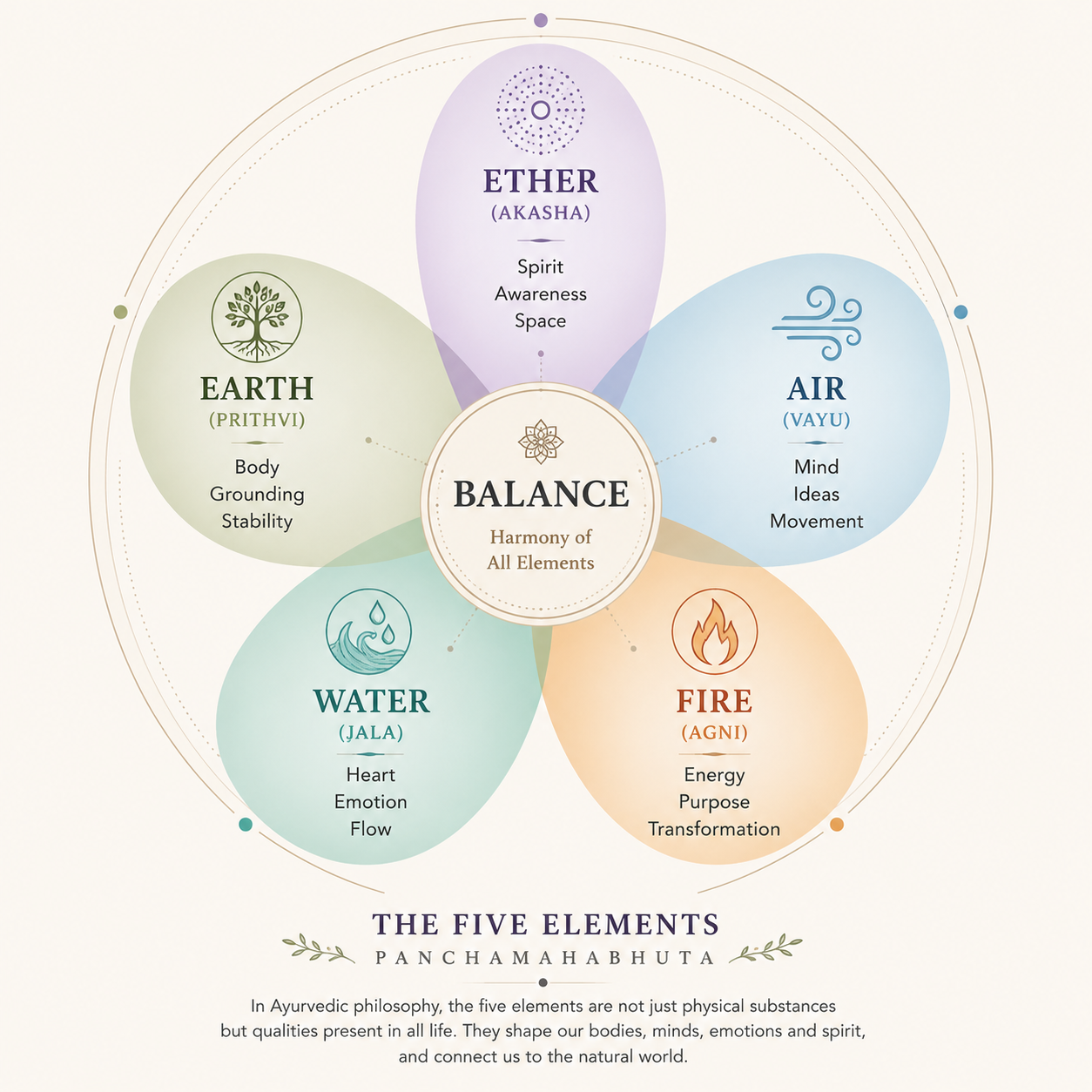
Ether — Akasha — the element of space, self, and centre
Akasha is the most subtle of the elements — the space in which everything else exists. In the body, it lives in the throat, in the cavities, in the pauses between breath. Psychologically, it is the dimension of pure being — the self beneath all the roles, the noise, the doing.
When ether is in balance, there is a quality of spaciousness — a capacity to simply be without needing to fix or become. When it is depleted, life feels crowded and airless, identity feels contingent and fragile, and the question who am I really becomes either urgent or completely inaccessible.
The practice of ether is returning to stillness. Not as an escape from life but as the ground beneath it. Meditation, silence, the deliberate pause. The question it asks is the most fundamental one: who am I beneath all the noise?
Air — Vayu — the element of mind, movement, and breath
Vayu governs the mind, thought, perception, communication, curiosity, and the movement of ideas. It is the quality of aliveness in the intellect, the desire to learn, the capacity to see things from new angles.
When air is in balance, the mind is clear, curious, and engaged. When it is excessive — as it so often is in modern life — we get overthinking, anxiety, scattered attention, and the inability to land anywhere. The mind moves faster than the body can follow.
The practice of air is nourishing the mind intentionally rather than letting it run on autopilot. Reading, learning, honest inquiry, and limiting the noise. The question it asks: how do I want to nourish my thinking, and what perspectives do I want to expand?
Water — Jala — the element of emotion, flow, and connection
Jala governs the emotional body — feeling, relationship, creativity, joy, grief, the full range of human emotional experience. It is the quality of flow, of movement, of things being able to move through rather than becoming stuck.
When water is in balance, emotions move freely — felt, expressed, released. When it is blocked, we get emotional stagnation: numbness, suppressed grief, the feeling of being cut off from genuine pleasure or connection. When it is excessive, we get overwhelmed, reactive, the sense of being flooded.
Trauma lives significantly in the water element — not as a metaphor but as a somatic reality. The body holds what hasn't been allowed to flow. Somatic therapy, creative expression, and honest relationships — these are water practices. The question it asks: what do I genuinely feel, and what needs to be allowed to move?
Fire — Agni — the element of spirit, transformation, and meaning
Agni is considered the most essential of the elements in Ayurvedic teaching — without functioning digestive fire, nothing transforms, nothing nourishes, nothing moves. This is as true psychologically as it is physically.
When fire is in balance, there is a quality of aliveness — a sense of direction, of values lived rather than just held, of genuine engagement with life. When it is depleted, we get burnout, apathy, the spiritual flatness of going through the motions. When it is excessive, we get intensity without direction, drive without rest, the burning that consumes rather than transforms.
Fire is what makes the Road of Trials navigable. It is the element that asks: what do I believe in that is larger than myself, and what am I willing to release for who I'm becoming?
Earth — Prithvi — the element of body, ground, and stability
Prithvi is the most dense, most physical of the elements. It governs the body's structure, nourishment, rest, the physical self that carries everything else. It is the quality of being held, of having ground beneath your feet, of the reliable continuity of a life with roots.
When the earth is in balance, the body feels cared for and inhabited rather than overridden or ignored. When it is depleted — as it so often is for people under sustained stress — there is a disconnection from physical reality, a neglect of basic needs, the sense of living entirely from the neck up while the body runs on empty.
Earth practices are the most practical: sleep, nourishment, movement, and rest. The question it asks is simple and often the most neglected: what does my body actually need right now?
These five elements are not separate forces. They are one living system — dynamic, seasonal, responsive to circumstances. The same person can be earth-depleted in winter and fire-excessive in summer. The same life transition can empty the water element and flood the air.
What makes the elements useful is precisely this — they don't tell you who you are in a fixed sense. They tell you where you are right now and what this particular moment needs. They make the invisible visible. They turn the vague sense that something is off into something specific enough to work with.
In my practice, I return to this compass with clients regularly. Where is the energy? Where is the depletion? What has been neglected? What is asking for attention?
The answers are usually already there, waiting to be named.
Where am I? What do I need? What is this moment asking of me?
That is the compass. And unlike a map, it works no matter where you are.
If you'd like to explore this in your own life, I'd be glad to walk alongside you.
Megan Shea is a trauma-informed psychotherapist and yoga-informed holistic counsellor integrating Vedic traditions, somatic therapy, nervous system awareness, and depth psychology. She works with adults online across Australia and worldwide.